Snow Days Were Sacred. Remote Learning Killed Them Quietly.
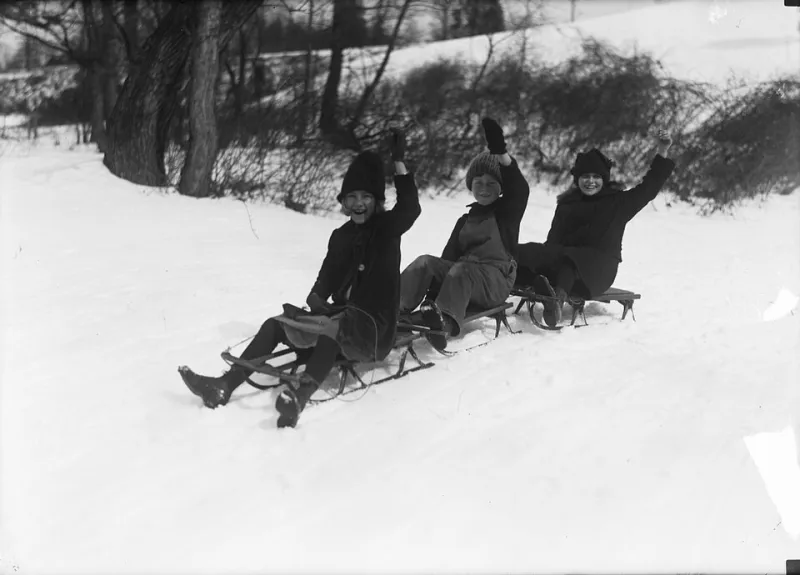
Photo: Harris & Ewing, photographer, Public domain, via Wikimedia Commons
For generations of American kids, a snow day wasn't just a day off school — it was proof that the world could still surprise you. No warning, no schedule, no plan. Just a voice on the radio at 6 a.m. and suddenly the whole day was yours. That particular kind of morning is becoming extinct, and the technology that replaced it understands everything about logistics and nothing about what was actually being lost.
The snow day as a cultural institution is in serious trouble. Not because winters have gotten milder — in many parts of the country they haven't — but because the administrative and technological infrastructure that once made cancellation the only option has been quietly replaced by an alternative that keeps the school day running regardless of what's happening outside. The pipes froze. The roads are impassable. Log on by 8:30.
What the Snow Day Actually Was
Ask anyone who grew up in the Northeast, the Midwest, or the mid-Atlantic about their best childhood snow day and you'll get a story that has almost nothing to do with snow. It's about the specific texture of unexpected freedom — the way the morning felt different the second you heard your school's name on the list, the way the day opened up in front of you with no structure and no demands.
The ritual had a precise sequence. You'd wake up earlier than usual, actually hoping school was canceled, which was already a strange inversion of normal feelings. You'd turn on the local radio or TV and wait through the alphabetical list of closings. When your district's name finally appeared, there was a jolt of pure, unearned luck — the kind that doesn't come with effort or planning, only with weather.
What followed was unscheduled time of a kind that is genuinely rare in a child's life. Not summer break, which is long enough to become its own routine. Not a weekend, which has its own predictable shape. A snow day was a single stolen day dropped into the middle of ordinary life. It belonged entirely to whoever could figure out what to do with it.
Sleds came out of garages. Snowball architectures were engineered in backyards. Kids who barely knew each other ended up on the same hill because that's where everyone went. Parents who couldn't get to work made pancakes. The whole household operated on a different frequency than usual — slower, warmer, slightly suspended from real life.
The Technology That Didn't Know When to Stop
The 2020 pandemic, whatever else it did, handed school districts across the country a fully operational remote learning infrastructure. Platforms like Google Classroom, Zoom, and Canvas were rushed into place, teachers were trained, and families were equipped with devices. When schools reopened, that infrastructure didn't disappear. It just sat there, waiting.
 Photo: Google Classroom, via themindstudios.com
District administrators — who had spent years facing criticism for snow days that ate into instructional calendars, triggered costly makeup schedules, and occasionally ran afoul of state minimum-hours requirements — saw an obvious solution. Remote learning days. Virtual snow days. Same storm, same closed roads, same two feet of snow in the driveway. Different outcome: school's technically in session, just on a screen.
By 2022 and 2023, dozens of states had passed legislation explicitly allowing districts to count remote learning days toward their instructional hour requirements, eliminating much of the administrative pressure that once made cancellation the default. The incentive structure had flipped. Calling a snow day was now the decision that required justification. Holding virtual school was simply the path of least resistance.
What Gets Labeled Efficiency
The case for virtual snow days is straightforward and not entirely wrong. Instructional continuity matters. Makeup days at the end of June are genuinely disruptive. Families who rely on school schedules for childcare logistics face real hardship when those schedules collapse without warning. These are legitimate concerns.
But the efficiency argument misses something important about what the snow day represented beyond its calendar function. It was one of the few remaining moments in a heavily scheduled American childhood when the system openly admitted it couldn't control everything. The weather won. The bureaucratic apparatus of compulsory education — with all its bells and schedules and standardized everything — simply had to yield to something larger than itself.
There's genuine value in a child experiencing that. Not as a lesson anyone planned, but as an accidental one. Some things are bigger than the schedule. Sometimes the world interrupts, and the right response is to let it.
Virtual school doesn't teach that lesson. It teaches the opposite one: that the system is now flexible enough to follow you anywhere, through any disruption, into your living room and your kitchen table and your snow pants that you put on and then took off again because apparently today is a school day after all.
The Overscheduled Backdrop
The snow day's decline also reflects something broader about the texture of American childhood. The kids who treasured snow days most were kids with genuinely unstructured time to fill — kids who spent their afternoons outside, whose weekends weren't fully programmed, who had the internal resources to improvise an entire day from scratch.
Today's children, particularly in middle-class households, live in a different kind of schedule. After-school activities, structured sports, tutoring, enrichment programs — the week is often as managed as any adult's calendar. A snow day for a heavily scheduled kid isn't necessarily the liberation it once was. It might just be a disruption to the disruption.
In that sense, the virtual snow day and the overscheduled childhood are symptoms of the same cultural shift: an increasing discomfort with unplanned time, a tendency to treat spontaneity as a problem to be solved rather than a gift to be received.
The Sound of the Radio at 6 a.m.
There's a specific sound that belongs to snow days and nothing else — the AM radio announcer reading school closings in alphabetical order, your district's name somewhere in the S's or the W's, and the way the whole morning changed the second you heard it. It's a sound that belongs to a particular era of American childhood, one that assumed the world could still catch you off guard.
Technology didn't set out to kill the snow day. It just made cancellation unnecessary, and in doing so, made surprise optional. And a surprise that's optional isn't really a surprise at all.
Some things are worth protecting precisely because they can't be scheduled.