One Ring, Whole House: The Shared Phone That Kept Families Accidentally Connected
If you grew up before the mid-1990s, you probably remember the specific tension of waiting for the phone. Your older sister had been on it for forty minutes. Your mom needed to call the vet. You had to reach your friend about the game tomorrow. One cord. One handset. One household negotiating a shared resource in real time.
It was inconvenient. It was occasionally maddening. And it turns out it was quietly doing something for family life that we didn't have language for until we lost it.
The Kitchen Phone as Household Hub
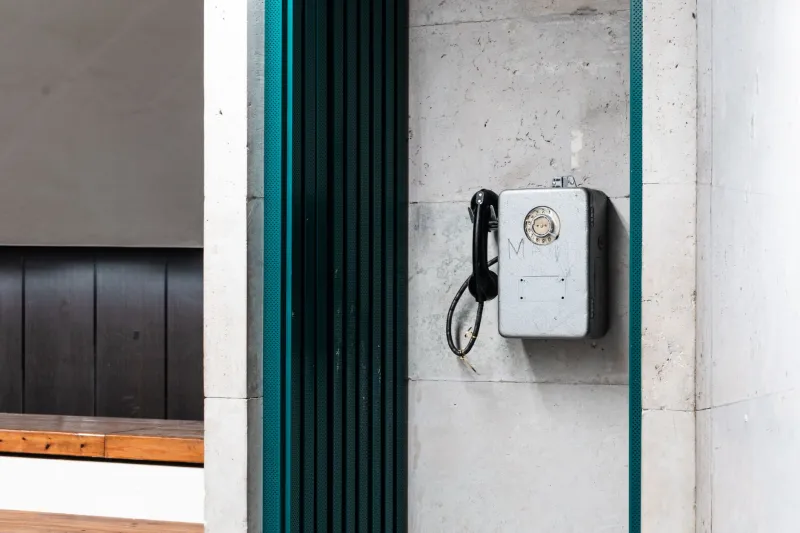
For most of the twentieth century, the telephone wasn't a personal device. It was a household one. In the 1950s and '60s, many American families still shared party lines with neighbors — meaning a call wasn't even private to your house, let alone to you as an individual. By the 1970s and '80s, the wall-mounted kitchen phone had become the default architecture of domestic communication, and the rituals around it shaped daily life in ways that are almost unrecognizable today.
Someone had to answer it. That was the first thing. The phone rang — loud, physical, impossible to ignore — and whoever was nearest picked it up. Which meant that parents routinely answered calls meant for their teenagers, teenagers answered calls meant for their parents, and everyone in the household had at least a passing awareness of who was calling and why. Privacy was limited. Awareness was high.
That awareness wasn't surveillance, exactly. It was just the natural byproduct of shared infrastructure. If your dad answered and it was your girlfriend calling, there was a thirty-second conversation before he handed it over. Small talk. Basic social courtesy. A moment of human contact that happened only because the technology required it.
Message-Taking as a Form of Care
Then there were the messages. Before voicemail became standard — and long before anyone could text — someone in the house had to take a message if you weren't home. That meant a small, specific act of attention: writing down the caller's name, their number, what they wanted, and leaving it somewhere you'd find it.
Families developed systems. A notepad by the phone. A corkboard above it. Some households had those novelty message boards shaped like a telephone. The messages themselves were artifacts — little paper records of who had tried to reach you, written in your mother's handwriting or your little brother's phonetic spelling.
This sounds trivial until you think about what it required. Somebody had to stop what they were doing, engage with a stranger or a friend on your behalf, represent you accurately, and make sure the information reached you. That's not nothing. It's a small act of service, repeated dozens of times across years, that quietly reinforced the idea that the people in your household were invested in your life.
Today a missed call goes to voicemail, or it doesn't. Nobody in your household knows it happened. Nobody has to care.
The Negotiation Nobody Talks About
Shared resources create negotiation. That's basic economics, and it applied to the family telephone with a particular intensity during the teenage years.
In households with one line and multiple people who wanted to use it, rules had to be established. Time limits. Priorities. An understanding that if you tied up the line for an hour, you were genuinely inconveniencing real people who were standing in the same kitchen. You could see their faces. You could watch your dad pointedly look at his watch. The social feedback was immediate and impossible to ignore.
This is fundamentally different from the experience of today's teenager, who has a device in their pocket that belongs entirely to them, whose usage affects nobody in the household, and whose digital life is essentially invisible to the people they live with. That invisibility comes with freedom, obviously. But it also comes with a kind of isolation that's hard to name when you're inside it.
The shared phone forced a degree of transparency that wasn't chosen — it was just structural. And that structure, inconvenient as it was, kept household members in each other's peripheral awareness in ways that mattered.
When a Call Was an Event
Here's something worth sitting with: before personal devices, receiving a phone call was an event.
Not a major event. But it had weight. The phone rang, you answered, and there was a person on the other end who had deliberately decided to reach you at this moment. Long-distance calls — to relatives in another state, say — were expensive enough that they usually happened on Sundays, and everyone in the house knew a long-distance call was coming. There was anticipation. The call meant something.
Compare that to today, when the average American sends and receives dozens of texts, notifications, and messages every single day, most of which register as barely conscious background noise. Communication has become so frictionless that individual messages have lost almost all of their weight. A text from your mom and a promotional email from a shoe company arrive in roughly the same way, with roughly the same urgency signal. The technology no longer distinguishes between them.
The old telephone made that distinction automatically. A call required effort — from the person making it and from the household receiving it. That effort was a signal. It said: this matters enough to do.
The Bubble We Built Ourselves Into
The personal smartphone is, by almost every measure, a more powerful and capable communication device than a rotary phone mounted to a kitchen wall. Nobody seriously argues otherwise. But capability and connection aren't the same thing.
When every person in a household has their own device, their own accounts, their own invisible streams of conversation, the household itself stops being a communication unit. Everyone is reachable — just not by the people in the next room. Family members can sit together in silence, each fully engaged with their own digital world, and call it an evening at home.
The shared phone didn't allow that. It put everyone's social life slightly in view of everyone else. It created friction, yes. It required compromise and patience and the occasional awkward handoff. But friction, it turns out, is sometimes how connection happens.
The ring that filled the whole house wasn't just a sound. It was an invitation — not just for whoever the call was meant for, but for everyone within earshot. And when we each got our own device, we stopped hearing each other's invitations entirely.