Your Word Was Your Bond: When Main Street Ran on Handshakes Instead of Fine Print

The Hardware Store Prophet
Every Tuesday morning for thirty-seven years, Jim Patterson walked into Kowalski's Hardware on Main Street in Cedar Rapids, Iowa, picked up a week's worth of supplies for his construction business, and walked out with a nod to Stanley Kowalski behind the counter. No cash exchanged hands. No invoices were signed. No credit cards were swiped.
 Photo: Kowalski's Hardware, via architizer-prod.imgix.net
Instead, Stanley kept a worn ledger book under the register where he tracked what Jim owed. At the end of each month, Jim would settle up—sometimes in full, sometimes partially if a job had been delayed. If Jim needed extra time, Stanley simply flipped to a fresh page and kept counting.
"My word was my credit score," Jim recalls. "Stanley knew I was good for it because he'd watched me work in this town for decades. His father sold nails to my father the same way. That's just how business worked."
The Reputation Economy
In mid-century America, local commerce operated on what economists now call "social capital"—the accumulated trust and reputation that individuals built within their communities. This wasn't naive optimism; it was practical economics. In a small town where everyone knew everyone, cheating someone meant destroying your ability to do business with anyone.
The local banker approved loans based on character references from neighbors. The grocer extended credit to families going through tough times. The auto mechanic fixed cars with the understanding that payment would come when it could. Contracts existed, but they were often secondary to the more powerful enforcement mechanism of community accountability.
Mary Ellen Thompson ran Thompson's General Store in Millerville, Pennsylvania, from 1948 to 1982. Her business model was elegantly simple: keep track of who owed what in a composition notebook, and trust that people would make good on their debts.
 Photo: Millerville, Pennsylvania, via kids.kiddle.co
"I had farmers who'd run a tab all winter and settle up after harvest," Thompson remembers. "Construction workers who'd pay weekly when they got their wages. Young couples just starting out who needed groceries but wouldn't get paid until Friday. It all worked because everyone knew that if you stiffed Mary Ellen Thompson, you'd have trouble buying groceries anywhere in three counties."
The Handshake Contract
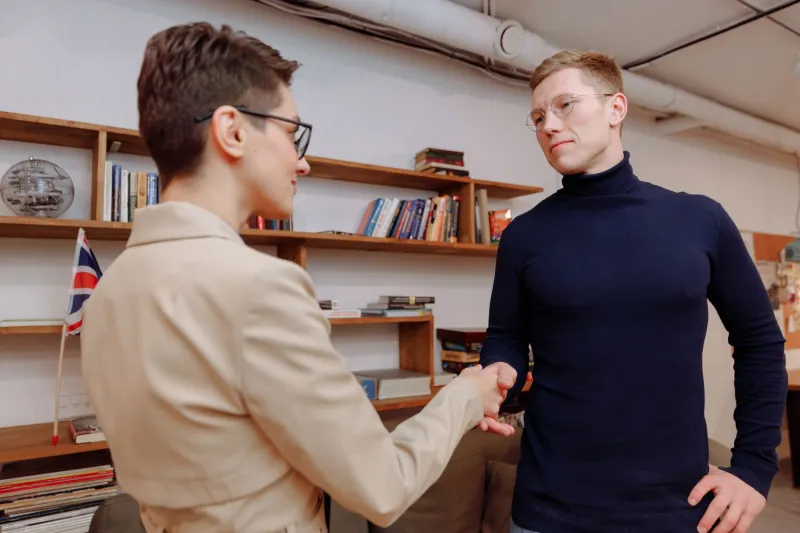
Business agreements in this era were often sealed with nothing more than a firm handshake and direct eye contact. This wasn't primitive capitalism—it was sophisticated social engineering. When your business reputation was your most valuable asset, violating a verbal agreement was economic suicide.
Charlie Brennan spent forty years buying and selling cattle across the Midwest. His biggest deals—transactions worth tens of thousands of dollars—were conducted at livestock auctions with nothing more than a nod and a handshake.
"I bought and sold millions of dollars worth of cattle on verbal agreements," Brennan explains. "If a man's word was no good, he couldn't do business. Period. The community would shut him out faster than any lawsuit could."
This system worked because it was self-enforcing. Reputation was currency, and currency required trust to function. Break that trust, and you were effectively bankrupt in the social economy that made local commerce possible.
The Liability Revolution
The shift from handshake deals to contract-heavy commerce didn't happen overnight. It evolved gradually through the 1970s and 1980s as businesses grew beyond local communities and legal liability became a primary concern.
The rise of national chains meant dealing with customers you'd never see again. Franchise operations needed standardized procedures that could work anywhere. Insurance companies demanded written documentation to limit exposure. What had once been relationship-based commerce became transaction-based commerce.
Today, buying a cup of coffee involves agreeing to terms of service. Purchasing a smartphone requires accepting a 15,000-word legal document. Getting your car repaired means signing liability waivers that would have been incomprehensible to Charlie Brennan's generation.
The Digital Distance
E-commerce has accelerated this transformation beyond recognition. Online platforms mediate transactions between strangers who will never meet, never shake hands, and never look each other in the eye. Trust has been replaced by algorithms, ratings systems, and return policies.
Consider the difference between buying furniture from Thompson's General Store versus Amazon. Mary Ellen Thompson knew your family, your financial situation, and your history in the community. She could extend credit based on character and collect payment based on relationship. Amazon knows your purchase history, your browsing patterns, and your credit score. It can offer financing based on data and collect payment based on automation.
Both systems work, but they operate on fundamentally different assumptions about human nature and commercial relationships.
The Cost of Protection
Modern commerce undeniably offers consumer protections that didn't exist in the handshake era. Standardized contracts prevent misunderstandings. Return policies protect buyers from defective products. Regulatory oversight limits fraud and abuse. These are genuine improvements that have made commerce safer and more predictable.
But we've also lost something valuable: the human element that made business personal. When your grocer knew your family's financial struggles, he might extend credit during tough times. When your mechanic had worked on your father's cars, he had incentive to maintain that multi-generational relationship. When your reputation mattered more than your credit score, there was social pressure to be trustworthy.
The Trust Deficit
Perhaps most significantly, the shift from reputation-based to contract-based commerce has fundamentally altered how Americans think about trust in business relationships. We now assume that everyone is trying to cheat us, so we demand legal protection for every transaction. This defensive mindset has become self-fulfilling: businesses respond to suspicious customers with increasingly complex terms of service and liability limitations.
The result is a commercial culture where trust has been replaced by verification, relationship has been replaced by transaction, and community accountability has been replaced by legal enforcement.
What We've Gained and Lost
Modern commerce is undeniably more efficient, more protective, and more scalable than the handshake economy of mid-century America. You can buy products from around the world, return defective items without argument, and conduct business with strangers without fear of fraud.
But efficiency came at the cost of intimacy. Protection came at the cost of flexibility. Scale came at the cost of community.
Jim Patterson, now retired, still drives past the empty storefront where Kowalski's Hardware used to operate. The building now houses a national chain store where every transaction requires a receipt, every return requires a manager's approval, and every customer relationship begins and ends with the scanning of a barcode.
"Stanley knew my kids' names," Patterson reflects. "The kid behind the register at the new place doesn't even know mine. That's progress, I guess. But it doesn't feel like improvement."