He Rang the Doorbell With a Toolbox: The Repairman Who Kept America Running
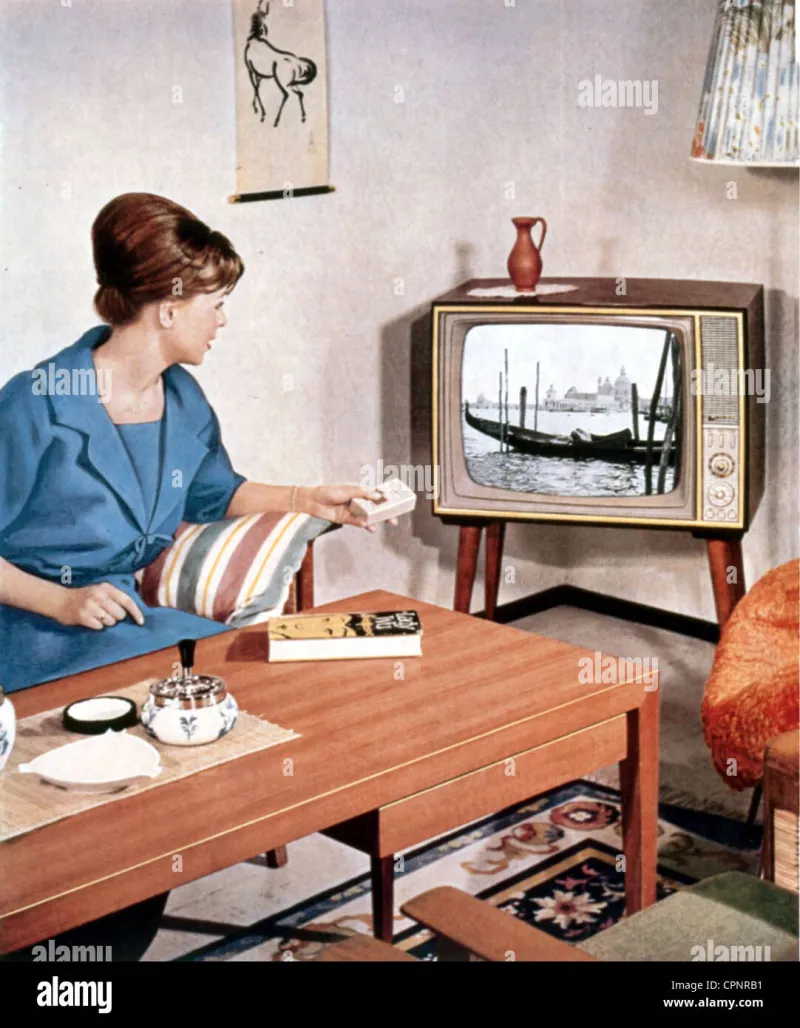
Photo: vintage appliance repairman fixing television in living room 1960s, via c8.alamy.com
Somewhere in the mid-1960s, a man named something like Earl or Vince would pull up to your house in a van with a hand-painted logo on the side, carry a worn metal toolbox through your front door, and spend the next ninety minutes resurrecting your broken television set on the living room floor. He'd done it a hundred times that month. He'd probably done it in your neighbor's house the week before. And when he left, your TV worked — sometimes better than it had in years.
That was just how things went. Appliances broke. People fixed them. Life continued.
It sounds almost quaint now. But for most of the twentieth century, the traveling repairman wasn't a novelty — he was a cornerstone of American household life.
A Trade Built on Trust and Torque
The postwar economic boom of the late 1940s and 1950s flooded American homes with new appliances at a pace the country had never seen. Washing machines, vacuum cleaners, electric ranges, and — perhaps most consequentially — televisions transformed the way families lived. By 1960, nearly 90 percent of American homes had a TV set. These weren't cheap purchases. A quality television in 1955 could run $300 or more, the rough equivalent of several thousand dollars today. Nobody was throwing one away because a tube burned out.
So an entire service economy grew up around keeping these machines alive. Appliance repair shops anchored small commercial strips in every town. But the real magic happened when the repairman came to you.
Service calls were standard practice. You'd call the number in the phone book — sometimes the same number you'd had for fifteen years — and within a day or two, a technician would show up, diagnose the problem, order the part if he didn't already have it in the van, and return to finish the job. Many of these men worked independently or in small crews. They knew which houses had the older Philco sets that needed a specific tube. They remembered that the Hendersons on Maple had a Maytag with a recurring belt issue. This wasn't a database. It was memory, built from years of showing up.
The relationship between repairman and household was genuinely personal. Families used the same guy for a decade. He'd fix the vacuum, then the toaster, then come back when the washing machine started making that noise again. There was a trust embedded in that dynamic that went beyond a service transaction.
When Fixing Was the Point
What made the repair economy work wasn't just the availability of skilled labor — it was the underlying assumption that things should be fixed. Appliances were designed with that expectation baked in. Components were modular and accessible. Manuals were written for human beings. Parts were stocked regionally and could be sourced without a weeks-long international supply chain scramble.
A mid-century washing machine was essentially a mechanical system a trained technician could diagnose by feel and sound. A television repairman carried a tube tester and a mental catalog of common failures for every major brand on the market. These weren't guesses — they were skills developed over years of hands-on work, passed down through apprenticeships and trade schools that took the craft seriously.
The economics made sense too. Labor costs were reasonable. Parts were available. And the alternative — buying a new appliance — was genuinely expensive. Repair wasn't just the ethical choice. It was the practical one.
How the Math Stopped Working
The unraveling happened gradually, then all at once. Through the 1970s and into the 1980s, manufacturing began shifting overseas, and the cost of new appliances started falling relative to wages. A washing machine that once represented a significant investment became, in relative terms, cheaper to replace than to repair. Manufacturers began designing products accordingly — not out of malice, necessarily, but because the market rewarded low upfront cost over long-term durability.
Circuit boards replaced mechanical components. Proprietary parts replaced standard ones. Warranty structures pushed consumers toward authorized service centers rather than independent technicians, and those centers were often more interested in selling a replacement than nursing an old machine back to health.
By the 1990s, the calculus had fundamentally shifted. When a mid-range microwave cost $60 at a big-box store, the $85 service call to fix the old one stopped making obvious sense. The repairman didn't disappear overnight — but his customer base eroded steadily beneath him.
What We Actually Lost
It's tempting to frame this purely as an economic story, but it was also a cultural one. The traveling repairman represented a specific kind of American worker — skilled, independent, embedded in the community, and valued for expertise rather than credential. These weren't college-track careers, but they were genuinely skilled trades that paid a living wage and commanded real respect.
Their disappearance wasn't just about appliances. It was about a shift in how Americans thought about ownership. When something breaks today, the default question isn't "who can fix this?" — it's "is it worth fixing?" And increasingly, by design, the answer manufacturers want you to reach is no.
The average American household now generates roughly 46 pounds of electronic waste per year. We discard coffee makers that need a $4 part. We replace blenders because the blade assembly is sealed and impossible to access. We upgrade phones not because the old one stopped working but because the software stopped being supported.
The Quiet Revival
There are signs, small but real, that the repair mindset is making a comeback. The right-to-repair movement has gained genuine legislative traction in several states, pushing back against manufacturers who lock down their own products. Independent repair shops are finding new audiences among younger consumers who've grown skeptical of the replacement treadmill. YouTube channels dedicated to appliance repair have millions of subscribers.
But it's not the same as Earl pulling up in his van and knowing your house, your machines, and your neighborhood by heart. That version of American commerce — local, skilled, relational — didn't just fix appliances. It held something together that's harder to put a price on.
Some things, it turns out, are worth trying to repair.