He Knew You Took Two Milks and Left the Paper by the Side Door
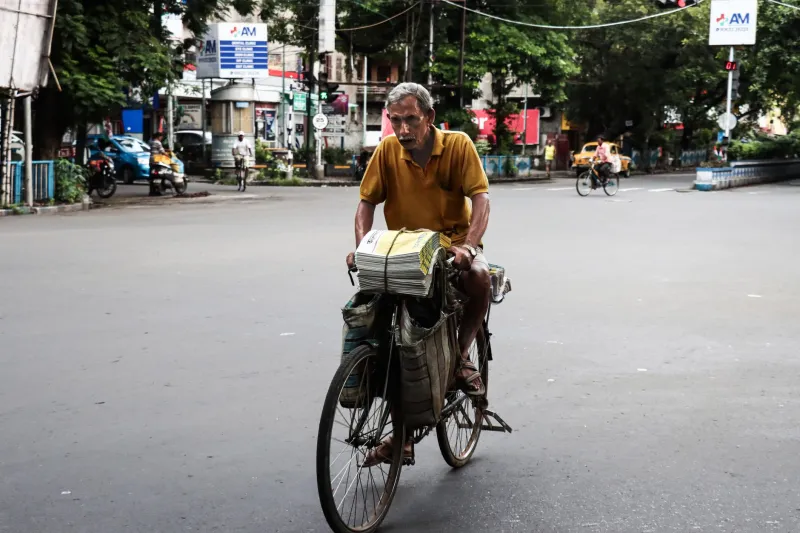
Somewhere around 4:30 in the morning, while the rest of the neighborhood was still dark and quiet, a kid on a bicycle was already moving. He knew this block the way a musician knows a song — not by thinking about it, but by feel. The Hendersons got the paper on the top step. The Garcias wanted it tucked under the mat when it rained. Old Mr. Kowalski at the end of the cul-de-sac got two copies on Sundays because he sent one to his sister in Cleveland.
This was the newspaper route. And for most of the twentieth century, it was one of the most reliable micro-institutions in American community life.
A Route Was a Relationship
The paperboy — and it was usually a boy, though not always — wasn't just a delivery mechanism. He was a familiar presence. Neighbors knew his name. They'd wave from the kitchen window. They'd leave a little extra in the Christmas envelope if he'd been reliable all year, which most of them were, because the route was personal. You weren't delivering to addresses. You were delivering to people.
The same logic applied to milk delivery, which was still common in many parts of the country well into the 1970s. The milkman came before sunrise, left glass bottles on the porch, and took the empties back. If you needed an extra quart for the week, you left a note. If you were going on vacation, you called and paused the delivery. The system required communication — actual, human communication — and that communication built a relationship over time.
These weren't deep friendships, necessarily. But they were something. They were the kind of low-stakes, recurring human contact that used to stitch neighborhoods together without anyone trying very hard. You didn't organize a community event. You just saw the same person every morning for three years and gradually started to know something about each other's lives.
What the Route Taught the Kid Running It
For the teenagers who worked paper routes, the job was also an education in accountability that's hard to replicate today. You had customers. They expected their paper before they left for work. If you were late, you heard about it. If you skipped someone, they called the circulation desk and you heard about it again.
You learned to manage a territory. You learned that some customers were easy and some were picky and some would invite you in for a glass of water on a hot July morning. You learned that showing up consistently, even when you didn't feel like it, was the whole job. No app tracked your performance. No algorithm optimized your route. You figured it out, and then you did it again the next day.
It was one of the most common first jobs in America for most of the twentieth century. By the 1990s, it was already fading. By the 2010s, it was essentially gone.
The Algorithm Doesn't Know You're on Vacation
Today's delivery infrastructure is, in purely logistical terms, extraordinary. Amazon can get a package to your door in hours. Grocery apps will bring food to your kitchen. A subscription box will arrive like clockwork based on whatever preferences you entered during a signup flow two years ago.
But the person who drops it off doesn't know you. They're not supposed to. The system isn't built around relationships — it's built around efficiency, and efficiency at scale doesn't have room for the kind of local knowledge that made the old routes feel personal.
The driver delivering your packages today might cover a different set of streets tomorrow. They're optimized by software, rated by an app, and moving too fast to notice that you always leave the porch light on when you're home. The route is a data point. You are a drop-off coordinate.
None of this is a criticism of the people doing the work — they're doing a hard job under real pressure. It's a description of how the system is designed. And the design doesn't leave room for the human texture that the old routes carried naturally.
What Got Delivered Along With the News
It's easy to romanticize the paperboy era, and worth being careful about that. The routes were often underpaid. The hours were brutal. The weather didn't care about your schedule. Milk delivery faded partly because refrigerators got better and supermarkets got cheaper, and that was a genuine improvement in everyday life.
But something real was lost when the familiar morning presence disappeared from American streets. Not just the service, but the signal it sent — that your neighborhood was inhabited by people who knew each other, at least a little. That the kid on the bike knew your porch. That the milkman remembered you switched to skim in January.
Those small recognitions weren't trivial. They were the texture of community. They were proof that you were known, in a modest but meaningful way, by the place where you lived.
Now the package arrives. The notification pings. Nobody rang the bell. And somehow the neighborhood feels a little quieter than it used to — not because it's actually silent, but because the kind of noise that meant something has mostly stopped.