The Porch Was the Original Feed: How America Moved Its Social Life Off the Front of the House
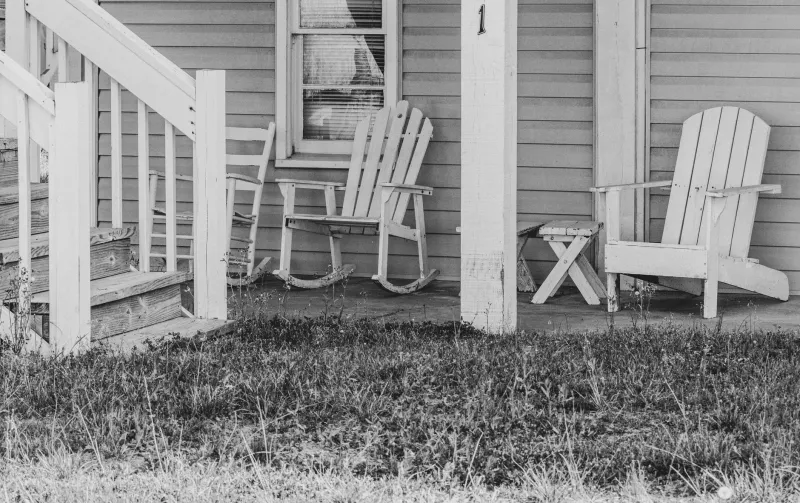
Walk down almost any American street built before 1945 and look at the houses. Nearly every one of them has a front porch — a real one, wide enough for chairs, maybe a swing, close enough to the sidewalk that you could have a conversation with a person walking a dog without either of you raising your voice.
Now walk through a subdivision built after 1990. The front door is a garage door. The actual front door is set back behind a facade of decorative brick, approached by nobody, because nobody's out there. If there's outdoor living space, it's in back — a patio, a deck, a privacy fence eight feet tall.
That architectural shift isn't a style trend. It's the physical record of how American community life came apart and reassembled itself somewhere else.
The Porch Was Doing Real Work
Historians of American architecture will tell you the porch hit its peak between the 1880s and the 1920s, and it wasn't decorative. Before air conditioning, the porch was the coolest room in the house on a summer evening. But cooling was only half the story.
The porch was a semi-public stage. You sat out there and you were visible. Neighbors walking by said hello. Kids selling raffle tickets knew exactly which house to hit. Gossip moved at the speed of a shouted sentence across a front yard. A stranger lingering too long got noticed. An elderly widow who hadn't come out in two days got noticed even faster.
Sociologists later gave this a fancy name — informal social control — but the people living it just called it knowing your neighbors. Crime stayed lower, kids behaved better, and nobody needed a neighborhood app to know what was going on, because the going-on was happening out loud, six feet from the sidewalk.
Then the Inside Won
What killed the porch? Not one thing — a pile of them.
Air conditioning arrived in force after World War II and made the indoors comfortable in July for the first time in human history. The automobile made the backyard garage-facing house cheaper and more desirable. Television made the living room more entertaining than the neighbor's porch. And postwar zoning — the great American art of separating everything from everything — produced cul-de-sac subdivisions where the houses face away from each other by design.
Architects noticed the change almost immediately. By the 1980s and '90s, the New Urbanism movement was explicitly trying to bring the porch back, with towns like Celebration, Florida and Kentlands, Maryland mandating front porches in their design codes. It was an admission that something had been lost and a belief, maybe optimistic, that architecture could restore it.
Sometimes it worked, sort of. But a porch with nobody on it is just a decorative memory.
The Porch Went Digital
Here's the twist: we didn't stop wanting the porch. We rebuilt it somewhere else.
The neighborhood Facebook group is the porch gossip circle, minus the faces. Nextdoor is the over-the-fence conversation, minus the fence. We still crave low-stakes, hyperlocal connection — we just moved it to a place where we can leave the conversation without standing up, where the stranger lingering too long can't be seen, and where the widow who hasn't posted in two days scrolls past unnoticed.
The old porch had something the feed doesn't: bodies in proximity. You couldn't be cruel to someone standing in your yard the way you can in a comment thread. You couldn't opt out of small talk with a thumb. The friction of physical presence — showing your face, waiting your turn to talk — was the moderation system.
What a Roof and a Swing Were Worth
Nobody's romanticizing this into something it wasn't. Porch culture was also surveillance, conformity, and a lot of small talk people were glad to escape. Privacy is genuinely wonderful. Air conditioning is one of the great public health achievements of the century, full stop.
But era by era, the trade becomes clear: we exchanged ambient community for curated connection. We used to know our neighbors because they were simply there, and so were we. Now we know the opinions of ten thousand strangers and can't name the person three doors down.
Some of it's coming back, in small ways. Front porch design is fashionable again. A few towns have started hosting porch concerts and porchfests. And every once in a while, on a summer evening in an older neighborhood, you'll see it: two lawn chairs, a glass of iced tea, somebody waving at the people walking by.
The best social network America ever built had a roof, a swing, and no algorithm. It's still standing on most of the old streets. All it needs is somebody sitting on it.