The C That Used to Mean Something: How America Stopped Grading Honestly

Photo: Unknown photographer, Public domain, via Wikimedia Commons
There was a time when bringing home a C in math didn't require a family meeting. A C meant you understood the material well enough, you were keeping up, and if you put in a bit more effort you'd probably do better next semester. It wasn't a crisis. It was information.
A D, on the other hand, got your attention. It meant something had slipped and needed to be addressed. And an F — well, an F meant you hadn't learned what you were supposed to learn, and the school wasn't going to pretend otherwise.
That system, imperfect as it was, rested on a foundational premise: grades were supposed to reflect reality. They were meant to tell students, parents, and eventually employers and colleges something honest about what a kid had actually mastered. Whether you liked what they said was beside the point.
Fifty years later, that premise has quietly eroded — and the consequences are more complicated than most people realize.
What the Numbers Actually Show
The data on grade inflation in American schools is striking, and it runs in one consistent direction. A 2022 analysis found that the percentage of high school students graduating with an A average has roughly doubled since the 1990s — rising from around 38 percent to nearly 55 percent — even as scores on standardized assessments like the SAT and NAEP (the National Assessment of Educational Progress, sometimes called the Nation's Report Card) have remained flat or declined over the same period.
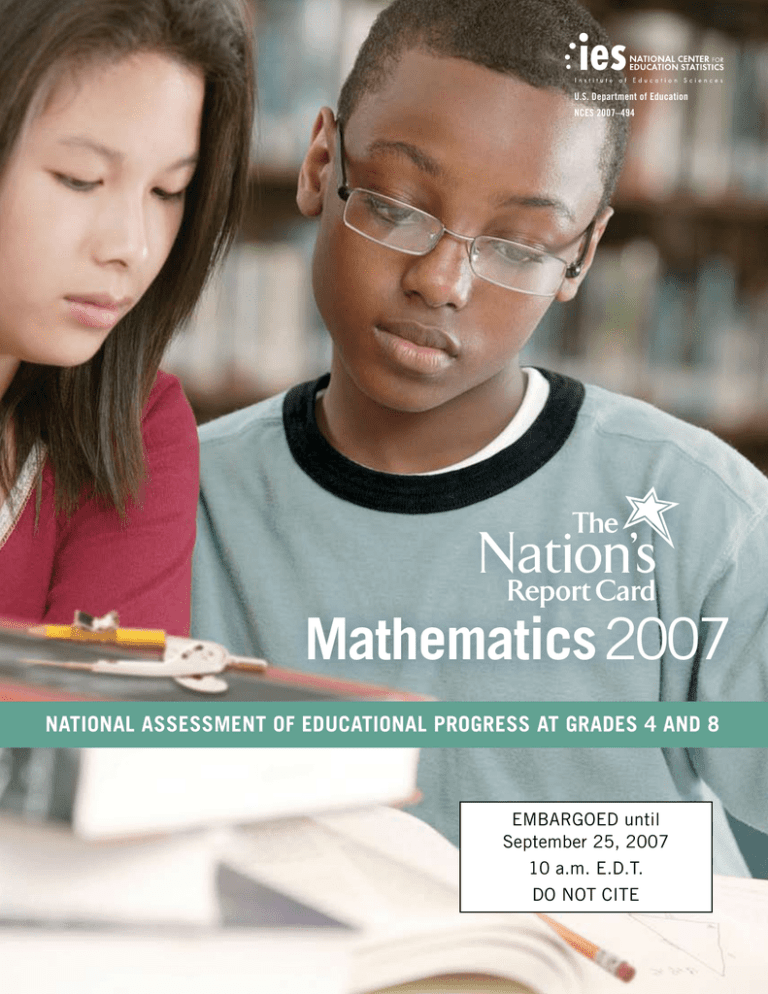 Photo: National Assessment of Educational Progress, via s2.studylib.net
Read that again: more A's, same or lower actual performance. The grades went up. The learning didn't follow.
At the college level, the trend is even more pronounced. In the early 1960s, the average GPA at American four-year colleges hovered around 2.5. By the 2010s, it had climbed past 3.1. Today, at many selective universities, A's are the single most commonly awarded grade. At some Ivy League institutions, more than half of all grades given are A's or A-minuses.
 Photo: Ivy League, via univadmithelp.com
This isn't an accident. It's the predictable output of a system responding to a set of incentives that have nothing to do with honest academic measurement.
How the Incentives Shifted
Understanding grade inflation requires understanding who benefits from it — and the answer is almost everyone in the short term, which is precisely what makes it so hard to reverse.
For students, higher grades mean better college prospects, more scholarship eligibility, and a smoother path through a system that increasingly treats academic credentials as the primary currency of adult life. The pressure on high school students to maintain a high GPA — not just a good one, but a near-perfect one — has intensified dramatically over the past three decades as college admissions competition has tightened.
For parents, higher grades reduce conflict with schools and validate the sense that their child is performing well. In an era when parental involvement in education has intensified to the point of occasional absurdity, schools have learned that giving a student a D is often the beginning of a lengthy, exhausting conversation with that student's family.
For teachers, inflated grades reduce friction. A classroom where most students are passing generates fewer complaints, fewer interventions, and fewer uncomfortable conversations with administrators. The teacher who grades strictly is often the teacher who spends the most time defending herself.
For schools and districts, high graduation rates and strong GPA averages look good in reporting metrics, affect funding formulas, and attract the kind of community confidence that keeps school boards happy.
The only party that doesn't obviously benefit in the short run is the student who needs honest feedback to actually improve.
The Standards That Moved
Grade inflation isn't just about teachers handing out unearned A's. It's also about the underlying benchmarks shifting. Over the past several decades, what a student is expected to demonstrate at each grade level has been renegotiated — sometimes deliberately, through curriculum reform, and sometimes organically, as teachers calibrate expectations to what students are actually producing.
Social promotion — the practice of advancing students to the next grade regardless of whether they've mastered the current year's material — became widespread in American public schools through the 1970s and 1980s, driven by legitimate concerns about the stigma of grade retention but without a clear alternative mechanism for ensuring skill mastery. The result, in many districts, was a generation of students who arrived in high school reading at a sixth-grade level and received grades that didn't reflect the gap.
The anxiety piece matters too. There's a genuine and well-intentioned movement in American education, rooted in research on student mental health and the psychology of failure, to reduce the punitive dimensions of academic assessment. The argument is that harsh grading damages self-esteem, increases anxiety, and can derail students who need encouragement rather than a red F at the top of a test paper.
The problem is that honest feedback and cruel feedback are not the same thing. A grade that accurately reflects what a student has learned isn't punishment. It's information. And removing that information doesn't make the gap disappear — it just makes it invisible until it surfaces somewhere less forgiving, like a job that requires the skill you were graded on.
The Downstream Problem
When grades stop being honest signals, the effects ripple outward in ways that compound over time. Employers have increasingly noted that college GPAs are poor predictors of workplace performance — in part because the signal has been diluted by inflation. College faculty report spending more time on remediation for incoming students who arrive with strong high school GPAs but genuine skill deficits in writing, math, and critical reasoning.
Perhaps most significantly, students themselves are often blindsided. A teenager who has been told through twelve years of schooling that she is performing at or above expectations is poorly prepared for the moment — in college, in a competitive job application, in a professional licensing exam — when an honest external assessment delivers a different verdict.
The kindness embedded in grade inflation is real. The harm embedded in it is also real. And the harm tends to arrive later, when the student has fewer resources to address it.
Measuring What Actually Matters
None of this is an argument for returning to a system where failure was wielded carelessly or where rigid grading served institutional sorting rather than student development. The old system had its own serious problems — it failed plenty of students who needed support rather than a red pen, and it often reflected racial and class bias as much as genuine academic performance.
But there's a version of honest grading that neither crushes students nor lies to them. It requires that grades mean something consistent and communicable — that a B in tenth-grade English signals roughly the same level of demonstrated skill regardless of which school issued it, which teacher assigned it, or which zip code the student lives in.
That version of honest measurement is harder to achieve than either harsh grading or inflated grading. It requires agreement on what mastery actually looks like, and the courage to say clearly when it hasn't been reached.
The report card used to try to do that. It wasn't perfect. But at least it was trying to tell you something true.