You Used to Pay for Things and Just... Leave
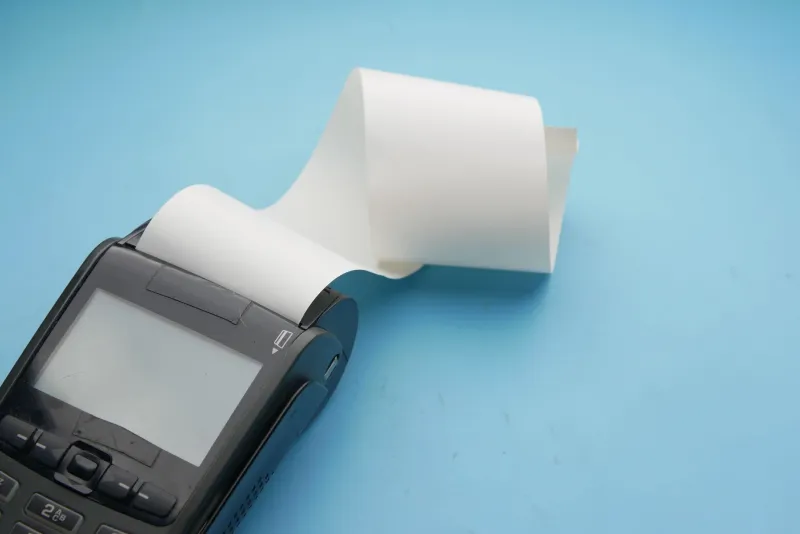
Picture a hardware store in 1978. You walk in, find what you need, bring it to the counter. The guy behind the register punches a few keys, tells you the total, and you hand over cash or write a check. He tears off a receipt about the size of a bookmark — item, price, total, done — and you put it in your pocket or throw it away immediately. Either way, you're out the door in ninety seconds.
Now picture buying a box of AA batteries at a big-box retailer today. The cashier asks if you have a rewards card. You don't. Would you like to sign up? It only takes a minute. You decline. Do you have the app? There are extra savings with the app. You don't have the app. Your total appears. You tap your card. A screen asks if the amount is correct. You confirm. Another screen asks how you'd like your receipt — paper, email, or text. You pick paper. The receipt prints. And prints. And prints. You finally get it: a thermal scroll listing your purchase, seventeen lines of fine print about the return policy, a survey invitation, a coupon for your next visit, and a barcode you'll never scan.
You've been at the register for four minutes buying batteries.
When a Transaction Was Just a Transaction
For most of American retail history, buying something was refreshingly uncomplicated. You exchanged money for goods. The receipt was a record of that exchange — a simple document meant to help you if something went wrong, not a marketing delivery system. Stores didn't need your email address. They didn't track what you bought last Tuesday. They didn't have a points system that expired if you didn't shop enough in a given quarter.
The relationship between a store and its customer was fairly clear: they had things, you wanted things, you paid a fair price, and everyone went home. Loyalty, to the extent it existed, was earned the old-fashioned way — through good service, fair prices, and staff who treated you like a person. You came back because the place was good, not because you were forty points away from a five-dollar coupon.
There was something honest about that arrangement. The store wanted your money. You wanted their product. The transaction was the whole thing.
How the Loyalty Card Changed Everything
The modern loyalty program didn't appear overnight. It crept in gradually, starting with airline frequent flyer miles in the early 1980s and spreading through grocery chains and drug stores by the 1990s. The pitch was straightforward: shop with us regularly and we'll reward you for it. That sounds reasonable, and in some ways it is.
But the loyalty card was never really about loyalty. It was about data. Every time you swiped that little keychain fob at the grocery store, you were telling the retailer exactly what you bought, when you bought it, how often you came in, and how price-sensitive you were. The discount you got on cereal was essentially a payment for that information. You just didn't know that's what the deal was.
Over the decades, the data collection got more sophisticated, the programs got more elaborate, and the friction at the register kept growing. Today's retail transaction can involve a phone number lookup, a barcode scan, a digital coupon clip, a credit card that also earns its own separate points, and a post-purchase survey. You're not just buying something — you're participating in a data ecosystem, whether you opted in or not.
The Psychological Cost of Points
There's another dimension here that doesn't get talked about enough: what loyalty programs do to the experience of shopping itself. When everything is gamified — when you're always tracking points, always calculating whether this purchase pushes you to the next tier, always wondering if you should wait for a double-points weekend — the act of buying something loses its simplicity.
You start making decisions based on the program rather than your actual needs. You shop at a store you don't love because you're close to a reward threshold. You buy more than you planned because there's a bonus offer. The program, which was supposed to benefit you, has subtly reshaped your behavior in ways that mostly benefit the retailer.
And when you do finally redeem those points? The reward is almost always underwhelming. That $10 certificate you've been accumulating toward for six months doesn't feel like a gift — it feels like getting back a small fraction of money you already spent.
What Simple Commerce Felt Like
There's a reason farmers markets and local shops have a particular appeal that goes beyond the products themselves. When you buy a jar of honey from the person who made it, the transaction is clean. You pay. You get honey. The exchange is complete. Nobody's capturing your purchase history. Nobody's sending you a follow-up email. Nobody's asking you to rate your experience on a scale of one to five.
That simplicity isn't just nostalgic — it's actually comfortable in a way that modern retail rarely manages to be. Because commerce, at its core, is supposed to be a human exchange. Something for something. Fair and done.
We traded that simplicity for points we mostly forget to use, inboxes full of promotional emails we didn't really want, and receipts long enough to wrap a birthday present. The stores got richer data. We got a slightly longer exit process and the vague feeling that somewhere, a server knows more about our shopping habits than we probably should have allowed.
The batteries work fine, though.